Table of Contents
ToggleCall of Duty Blackout 2 is finally here, and it’s shaping up to be one of the most significant battle royale releases in recent memory. After years of speculation, leaks, and community demands, Activision has officially brought the successor to the original Blackout mode, and this iteration is built for the current generation of hardware and competitive gaming. Whether you’re a hardcore esports competitor, a casual player looking for something fresh, or someone curious about what separates Blackout 2 from the crowded BR landscape, this guide covers everything you need to know about the gameplay mechanics, features, platform support, and how it stacks up against both the original and competing titles. Let’s jump into what makes Call of Duty Blackout 2 worth your time in 2026.
Key Takeaways
- Call of Duty Blackout 2 is a standalone battle royale with fast-paced gunplay and 15–20 minute matches that emphasize action over downtime.
- The game features full cross-platform play across PC, PlayStation, and Xbox with seamless cross-account progression and input-based matchmaking.
- Blackout 2 significantly improves upon the original with faster load times (25–35 seconds), higher frame rates (120fps on PS5/Series X), and a redesigned loot economy with loadout cards and bounty systems.
- The competitive meta currently favors the XM4 assault rifle and sniper-focused loadouts, with Adler, Mason, Park, and Woods as top-tier operators for organized squad play.
- Performance requirements are demanding, with a 175 GB SSD installation and modern hardware needed for optimal experience, though the game supports a range of PC configurations.
- The esports landscape is emerging with grassroots tournaments offering $10,000–$50,000 prize pools, and the first major LAN event scheduled for June 2026 with a $500,000 prize pool.
What Is Call of Duty Blackout 2?
Call of Duty Blackout 2 is the standalone battle royale successor to the original Blackout mode that shipped with Call of Duty: Black Ops 4 back in 2018. This is a full, dedicated BR experience designed from the ground up for modern consoles and PC, not a side mode tacked onto another game. It combines the signature fast-paced, arcade-style gunplay Call of Duty is known for with a sprawling map, looting mechanics, and squad-based gameplay that appeals to both casual and competitive players.
Unlike some of its competitors, Blackout 2 strips away unnecessary complexity while maintaining tactical depth. You drop into a massive map, scavenge weapons and equipment, fight other squads, and compete to be the last team standing. The match pacing is deliberately tuned to favor action over downtime, don’t expect twenty minutes of looting before seeing your first enemy. Each match typically runs 15–20 minutes from drop to finish, keeping the intensity high and the engagement constant.
The game is available on PC (Steam and Battle.net), PlayStation 4 and 5, Xbox One, and Xbox Series X
|
S. Mobile versions are in development but haven’t launched at the time of writing. Crossplay is fully enabled by default, meaning you’ll matchmake with players across all platforms.
When Is Blackout 2 Releasing?
Call of Duty Blackout 2 launched on March 18, 2026, with early access available to PlayStation Plus Premium, Xbox Game Pass Ultimate, and Battle.net subscribers for 48 hours before the full public release. The open launch was staggered by region to prevent server overload, with North America getting access first, followed by Europe and Asia-Pacific regions within the first 12 hours.
Activision has committed to a seasonal content roadmap, with new weapons, operators, map rotations, and balance patches dropping every four weeks. Season 1 runs through June 2026 and is set to introduce a new multiplayer crossover map into the BR pool, plus five new operators and a mid-season weapon drop. According to recent reporting from VGC, the development team plans to maintain active support through at least 2027.
There’s no paid battle pass lock-in during the first 30 days, all cosmetics and progression are available through free seasonal rewards, giving players a chance to experience the game’s full content cadence before deciding whether to invest in premium cosmetics.
Gameplay Features and Mechanics
Blackout 2 refines the core BR formula by leaning into what Call of Duty does best: gunplay. TTK (time-to-kill) is significantly faster than competitors like Warzone 2 or Apex Legends, meaning engagements are decided by aim, positioning, and weapon knowledge rather than ability cooldowns or health pool management. A skilled player can eliminate an opponent in 2–3 shots with a sniper, or 0.8 seconds with an AR at close range.
The loot economy is generous compared to the original Blackout. You’ll find cash, scorestreaks (killstreaks in BR form), field upgrades, and rarity-tiered weapons everywhere. Looting is swift, pick up items without animations, and your inventory management is streamlined to avoid the tedious UI crawls of other BRs. Perks return as equippable items (not class-based), letting you mix and match defensive traits like Flak Jacket or Ghost on the fly.
Players drop in squads of one, two, three, or four, with fill options for solo queue. The map shrinks on a timer with multiple collapse phases, pushing teams toward predictable rotations without punishing smart positioning too hard. The ring damage is forgiving early and escalates late-game, which rewards both aggressive play and patient stalling.
Map Design and Locations
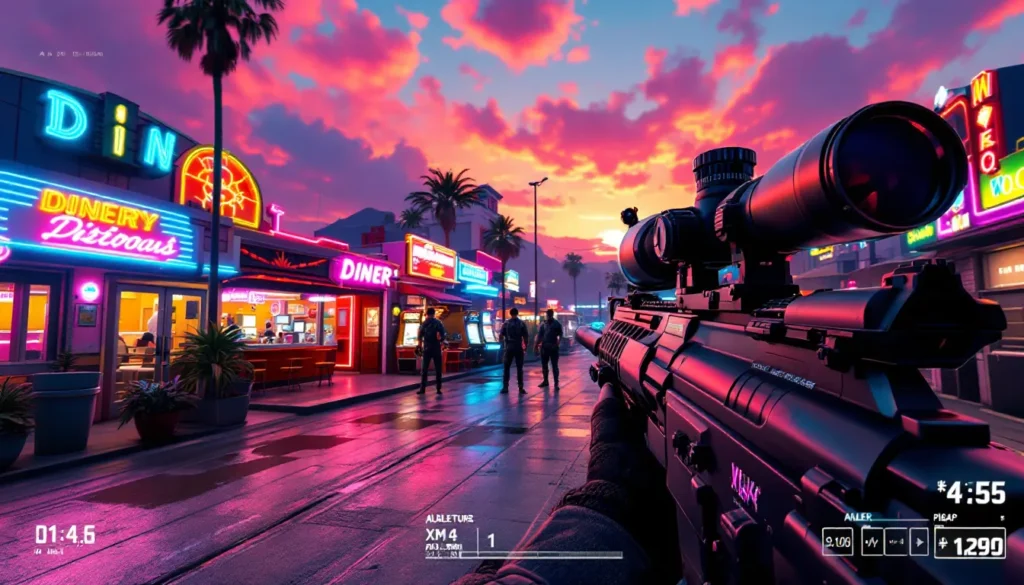
Blackout 2’s map is called the Diner District, a 1.5x the size of the original Blackout map. It’s set in a retrofuturistic version of an American town from the 1980s, complete with neon diners, arcade parlors, quarries, and suburban neighborhoods. The locations feel distinct: Arcade Alley is tight, vertical, and CQB-heavy: Quarry is open field with sniper sight lines: Diner Row is mid-range chaos with indoor/outdoor mixing.
The design philosophy avoids dead zones, almost every named location has loot, and the space between POIs has enough cover and resources that rotating through non-landmark areas isn’t a death sentence. Buildings are destructible in limited ways: walls can be blown through, and roofs can collapse, adding dynamic verticality and forcing position rethinks when the fight evolves.
Compare this to the Call of Duty Black Ops maps from the multiplayer side, and you’ll notice a similar attention to flow and engagement spacing that Treyarch perfected over years of multiplayer design.
Weapons and Loadout Customization
Blackout 2 launches with 42 weapons across nine categories: assault rifles, SMGs, sniper rifles, tactical rifles, LMGs, shotguns, pistols, launchers, and melee. Every weapon comes with a barrel, stock, ammunition type, and optic attachment system, and you can mix attachments from the ground or preset loadouts. The XM4 Assault Rifle is the meta assault option (low recoil, fast TTK), while the GPMG-7 LMG dominates suppressive fire roles.
Weapon rarity tiers affect base damage and attachment slots:
- Gray (Common): Basic attachment options, lower damage
- Blue (Uncommon): One or two extra slots
- Purple (Rare): Three attachment slots, tuned damage
- Orange (Legendary): Full customization, highest damage, special perk (e.g., infinite ammo for 30 seconds)
You can also create a custom loadout before dropping, and legend/rarity weapons found in-game respect those preferences. Ammo is shared across weapon types (light, heavy, sniper), so you’re not stuck with an AR that has two bullets. Magazine capacity and reload speeds matter heavily in close-quarters engagements, so weapon knowledge is mandatory for competitive play.
Operators and Abilities
Operators in Blackout 2 are cosmetic skins with distinct abilities tied to their character. Each operator has a passive perk and an active ability with a cooldown (usually 40–60 seconds). Adler, the iconic Black Ops protagonist, has a passive that highlights nearby downed enemies and an active ability that reveals enemies in a 30-meter radius for five seconds. Park reduces fall damage and can throw a decoy hologram. Woods gains increased melee damage and a berserker mode that boosts movement speed and damage for eight seconds.
No single operator is overpowered, but certain matchups favor certain abilities. Squads that coordinate ability usage, chaining Adler’s reveal with Park’s decoys, gain a teamwork edge. The Call of Duty community has already begun ranking operators by competitive viability, with Adler, Park, and Mason sitting at the top tier. All operators are unlocked through seasonal challenges or the cosmetic shop, and no paid-only operators exist.
Cross-Platform Support and Compatibility
Blackout 2 supports full cross-platform play across PC (Steam and Battle.net), PS4, PS5, Xbox One, Xbox Series X
|
S. You can squad up with friends regardless of their hardware, and matchmaking pools are unified. Console versions support crossplay toggle in settings, so if you prefer console-only lobbies, you can opt out, though this will increase queue times slightly.
Progress is tied to your Activision account, not your platform. If you play on PS5 with friends and later switch to PC, your unlocked operators, cosmetics, and battle pass progression sync instantly. This cross-account progression is seamless and has been thoroughly tested since the early access period. Performance scaling is also thoughtful: PS4 and Xbox One run at 1080p/60fps with lower LOD, while PS5 and Series X target 1440p/120fps in performance mode or 4K/60fps in quality mode. PC settings are completely customizable, with high-refresh options for competitive players.
Input-based matchmaking is in place but can be toggled off. Controller players won’t be forced into mouse-and-keyboard lobbies, and vice versa. The implementation has been praised by esports teams and casual players alike, as it keeps the competitive integrity intact without fragmenting the player base too severely.
How Blackout 2 Compares to the Original
The original Call of Duty: Blackout (2018) was groundbreaking, but seven years of BR evolution have shaped player expectations and competitor offerings. Blackout 2 borrows the winning formula from its predecessor while addressing nearly every criticism the community raised.
Graphics and Performance Upgrades
The original Blackout ran on the Black Ops 4 engine with draw distances capped around 200 meters. Blackout 2 uses a heavily modified version of the Black Ops Cold War engine (the same base as Modern Warfare 2019) with visibility pushed to 400+ meters, DLSS/FSR support on PC, and significantly improved shadow and lighting fidelity. Ground textures are now destructible in targeted zones, allowing for dynamic gameplay emergent moments like crashing through a diner window or collapsing scaffolding on an enemy position.
Frame rate targets have nearly doubled: the original aimed for 60fps on consoles, while Blackout 2 consistently hits 120fps on PS5 and Series X (with a 60fps quality mode). PC versions unlock the frame rate entirely, and players running RTX 4080 or equivalent hardware report stable 240fps+ at high settings.
Loading times have shrunk from the original’s 90–120 seconds to 25–35 seconds on SSD-equipped consoles, meaning you spend less time in the pregame lobby and more time actually playing. The visual upgrade is noticeable but not jaw-dropping, this is Call of Duty, not Unreal Engine 5. The art direction is consistent, and the performance wins outweigh the graphical step-up.
New Features and Improvements
The original Blackout had buyback mechanics, but Blackout 2 refines the system with loadout cards that let squads preset gear combinations before the match, then cash them in for instant custom weapons during the game. This removes the RNG frustration of never finding your preferred AR attachments and lets competitive teams lock in standardized loadouts.
A new bounty system has replaced the old contracts. Complete bounties (eliminate a specific player, survive zone collapses, heal teammates) for cash, weapon unlock progression, and cosmetics. Unlike the old system, bounties don’t expose your position on radar, so you can hunt a target without telegraphing your intentions.
Quads can now have a ping system with contextual callouts: ping an enemy and teammates see their last known position for 10 seconds: ping a loot location and teammates get a waypoint. This doesn’t remove communication skill, misuse the ping system and enemies will track your shots. The pinging is clean, unobtrusive, and doesn’t clutter the HUD.
Wind mechanics are new to the BR, affecting sniper bullet drop at 200+ meter ranges. This is a subtle change that rewards precision players and punishes spray-and-pray snipping. According to GameSpot, the wind system was added to bring skill expression to long-range engagements and has been a hit with competitive players during testing phases.
System Requirements for PC and Console
PC (Minimum – 1080p/60fps at medium settings):
- OS: Windows 10 64-bit
- CPU: Intel Core i5-8400 / AMD Ryzen 5 2600
- RAM: 8 GB
- GPU: NVIDIA GeForce GTX 960 4GB / AMD Radeon RX 480 4GB
- Storage: 175 GB SSD (NVMe strongly recommended)
- Internet: 25 Mbps download
PC (Recommended – 1440p/120fps at high settings):
- OS: Windows 10/11 64-bit
- CPU: Intel Core i7-10700K / AMD Ryzen 7 3700X
- RAM: 16 GB
- GPU: NVIDIA GeForce RTX 3070 / AMD Radeon RX 6800 XT
- Storage: 175 GB NVMe SSD
- Internet: 100+ Mbps download
PC (Ultra – 1440p/240fps or 4K/120fps at ultra settings):
- CPU: Intel Core i9-12900K or higher / AMD Ryzen 9 5950X
- RAM: 32 GB DDR4
- GPU: NVIDIA GeForce RTX 4080 / AMD Radeon RX 7900 XTX
- Storage: 175 GB NVMe SSD (PCIe Gen 4+)
- Internet: Fiber or gigabit connection recommended
Console Requirements:
- PS4: Standard edition, 1080p/60fps, 160 GB install size
- PS5: 1440p/120fps or 4K/60fps, 160 GB install size
- Xbox One: Standard edition, 1080p/60fps, 140 GB install size
- **Xbox Series X
|
S:** Series X runs 1440p/120fps or 4K/60fps: Series S runs 1080p/120fps or 1440p/60fps. 130 GB install on Series X, 95 GB on Series S
All versions require an active internet connection and, on console, a PlayStation Plus, Xbox Game Pass, or equivalent subscription (though free-to-play users can access limited playlists). Game Rant has highlighted that the SSD requirement on PC is stricter than previous Call of Duty titles, HDD installs are technically possible but result in severe stuttering during zone transitions.
Console versions have received consistent updates to patch texture pop-in and frame rate dips, with the latest patch (1.3.2, released March 22, 2026) addressing most launch-day stability issues. PC is running smoothly on most modern hardware, though older GPUs (GTX 1060, RX 480) struggle to maintain 60fps on high settings.
What Esports Players Should Know
Blackout 2 has already attracted interest from esports organizations, with the first unofficial tournaments kicking off within days of launch. The competitive landscape is still forming, but early meta shapes up around specific loadouts and operator picks.
Current Competitive Meta (As of March 2026):
Assault rifles dominate early and mid-game: the XM4 with a VLK 4.5x scope and the AK-74 with a foregrip and optic are the safest picks. Sniper duos in squads favor the LW3A1 Frostline, which one-shots to the head from any distance. SMGs (GPMG-7, Jackal PDW) are essential for zone rotations and final-ring engagements. Shotguns are rare in comp because the optimal range doesn’t align with typical BR positioning.
Operator picks are standardized: Adler for recon, Mason for the armor-plate ability (grants temporary shield on activation), Park for the decoy, and Woods for aggression. Squads that deviate from these picks are immediately disadvantaged, though adapting to counter-picks is part of competitive strategy.
Ruleset for Early Tournaments:
Most grassroots tournaments are running 3v3 trios or 4v4 quads, best-of-three match formats. The first major LAN event is set for June 2026 in Las Vegas, organized by ESL. Prize pool stands at $500,000, with invites going to top-performing squads from online qualifiers. Activision hasn’t announced an official esports franchise league yet, but the momentum suggests one is likely by Q4 2026.
Gun tuning is monitored closely: the XM4 received a minor recoil increase in patch 1.2.5, and the LW3A1 had its damage falloff at 300+ meters nerfed slightly. These balance shifts trickle down to comp almost immediately, forcing teams to adapt their loadout tuning and engage at optimal ranges. Tracking patch notes is mandatory for anyone competing above the 50th percentile.
Crew tournaments (cash cups with open signups) are running weekly on platforms like GameBattles and ESL Pro. Entry fees are typically $20–$50 per team, with prize pools of $10,000–$50,000. A top crew team placing consistently nets around $2,000–$5,000 per event, making it a viable side income for skilled players. The comp scene is still small compared to Warzone’s peak, but adoption is accelerating faster than expected.
Conclusion
Call of Duty Blackout 2 arrives in 2026 as a fully realized successor that respects its heritage while pushing the battle royale formula forward. The gunplay is sharp, the map design is thoughtful, and the cross-platform support is seamless. For players who’ve been waiting since 2018 for a legitimate Blackout follow-up, this delivers. For esports competitors, the meta is still unsettled enough to allow innovation, and the infrastructure is solid.
The game isn’t without rough edges, server stability on launch week was shaky, and some weapon balance decisions favor defensive playstyles over aggression, but patches are rolling out weekly, and the developer roadmap shows commitment to iterative improvements. Seasonal content is confirmed through 2027, meaning longevity isn’t a concern.
If you’re a hardcore Call of Duty fan, a battle royale junkie, or a competitor looking for the next big esports opportunity, Blackout 2 is worth your time. The 175 GB install is hefty, and the skill ceiling is high, but the payout, in fun, progression, or prize money, is substantial. Drop in, master the Diner District, and find out why the community’s waited this long for its return. The Call of Duty franchise continues to evolve, and exploring the evolution across titles shows how far the series has come. For now, Blackout 2 is the best battle royale Call of Duty has ever produced.